
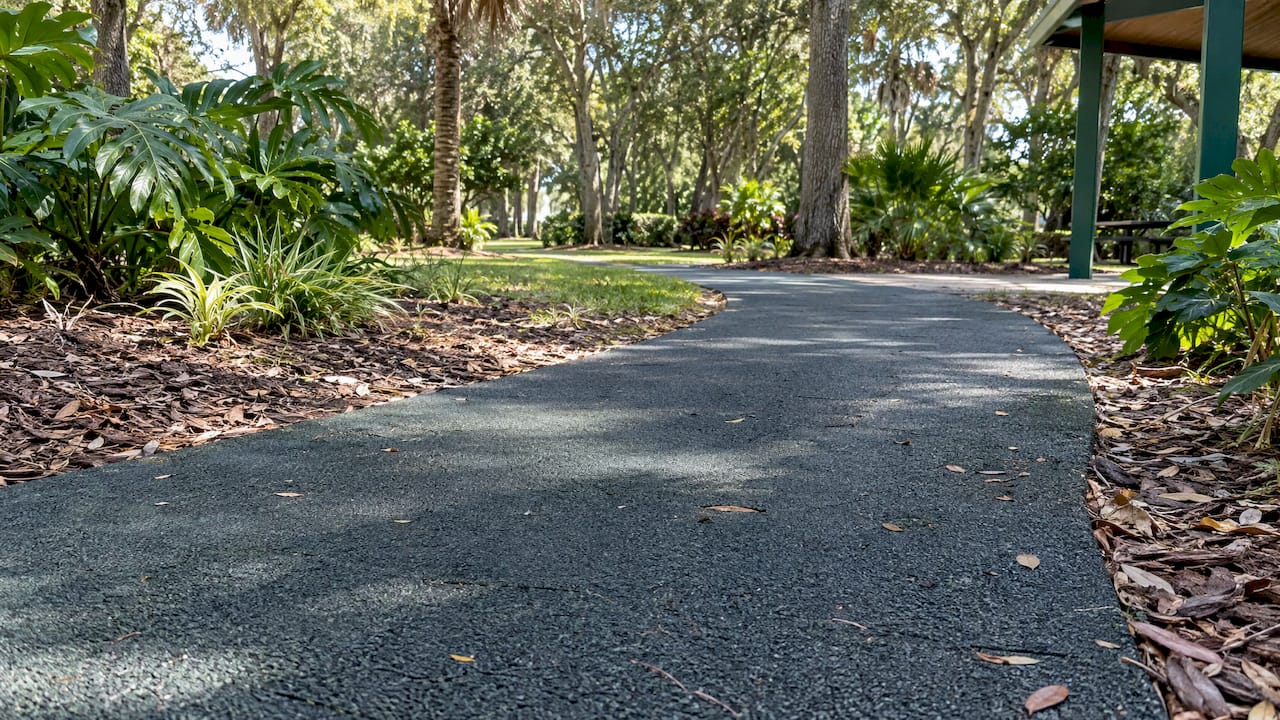
Asphalt is a petroleum product by definition, so a petroleum-free surface starts with a different material or a different binder. Bio-based binders are still in the lab and on test sections. Surfaces you can specify now are resin-bound aggregate, pervious concrete, permeable pavers and recycled-material porous paving. For Florida properties that need drainage, crack resistance and ADA-compliant paths, we install the Rubberway® system, which is built from recycled tire materials and keeps waste out of landfills while replacing conventional paving.
TL;DR
- Asphalt is made from petroleum distillation residue, and its binder is what holds the pavement together. Removing petroleum means replacing that binder or the whole surface.
- Fully non-petroleum road binders exist in research, but reviews say most still cannot replace bitumen outright. Don't plan a project around them yet.
- Permeable surfaces cut stormwater runoff and surface heat, which matters on Florida driveways, pool decks, trails and community areas.
- Any path open to the public must be firm, stable and slip resistant under ADA rules. Check this before choosing a material.
- Recycled-material rubber paving gives homeowners, HOAs, municipalities and golf courses a porous, crack-resistant surface installed as a complete project.
Table of Contents
- Why asphalt can never be petroleum-free
- Can the binder be replaced? Where bio-binders stand
- Surfaces that skip asphalt
- Drainage and heat: where permeable paving earns its place
- ADA checks for any path you replace
- Life cycle: what happens at the end
- Our point of view
- How to choose for your property
- Rubber paving for Florida properties
- FAQ
- Sources
Why asphalt can never be petroleum-free
The U.S. Energy Information Administration defines asphalt as a cement-like material obtained by petroleum processing, with bitumens as its predominant component. A University of Wisconsin transportation bulletin explains that it is what remains after crude oil is distilled into fuels and lubricating oils. The same bulletin reports that about 96% of the 2.4 million miles of paved U.S. roads use some type of asphalt.
The EPA's guidance on asphalt paving operations splits the pavement into two jobs. Aggregate, meaning stone, gravel or soil from a quarry, carries the load, takes wear and provides a nonskid surface. The petroleum-derived binder (asphalt cement, cutbacks or emulsions) holds that aggregate together and makes the cover waterproof.
So "asphalt without petroleum" is a contradiction. Your realistic options are:
- Replace the binder with something renewable.
- Replace asphalt with another type of surface altogether.
The rest of this article covers both.
Can the binder be replaced? Where bio-binders stand
Researchers have worked on this for years. A Federal Highway Administration fact sheet describes Washington State University work on a binder made from waste cooking oil, combined with lignin, a paper-pulping byproduct, to improve stability at high temperatures. A 2025 study proposed a fully non-bituminous binder made of waste cooking oil, rosin resin ester, cellulosic pulp and an isocyanate prepolymer. Under American standards it would suit pavement design temperatures only up to 70°C.
The practical picture is more cautious. A 2022 review sorts bio-binders into three groups by how much bitumen they replace: direct alternatives (75 to 100%), extenders (10 to 75%) and modifiers (under 10%). It finds that most bio-based binders still lack the properties to fully replace bitumen. The modifier route, under 10%, is the most feasible today. An Iowa State University study adds that bio-oils need heat pre-treatment or upgrading before they work as pavement binders, and that testing standards would need to change.

For an owner, board or public works department, this means bio-binders are a research story, not a product you can bid on for next spring's driveway, trail or parking area. The surfaces below are what you can specify now.
Surfaces that skip asphalt
The EPA's heat island compendium lists several non-asphalt pavement types. One is resin-based pavement, which uses clear tree resins instead of petroleum-based elements to bind aggregate. It also lists pervious concrete, permeable pavers, and grass or concrete grid pavers. The EPA's Green Parking Lot Resource Guide adds gravel, cobble, brick, open-jointed pavers and turf blocks as permeable alternatives that slow runoff and let water filter into the soil.
Here is how the main families compare for a Florida owner:
| Surface type | How it holds together | Where it fits | What to weigh |
|---|---|---|---|
| Resin-bound aggregate | Tree-resin binder | Paths, plazas | Specialized installation |
| Pervious concrete | Cement paste, little fine material | Parking, walkways | Cement is energy intensive to produce |
| Permeable pavers | Individual units, open joints | Driveways, patios | Joints must stay stable and clear |
| Crushed stone or gravel | Compaction | Trails, low-traffic paths | Needs stabilizing to meet ADA firmness |
| Recycled-material rubber paving | Porous, bonded recycled tire material | Driveways, pool decks, trails, sidewalks, parks, community areas | Installed as a complete system |
Cement deserves a note. It contains no petroleum, but its production is energy intensive. If your goal is lower environmental impact overall, not only petroleum-free, look at the whole picture of materials, waste and water.
Recycled content is a second route to the same goal. Seattle's green home guide notes that recycled glass pavers can contain up to 100% recycled content and take roughly half the energy to make that new concrete pavers do. Recycled tire material follows the same logic: it turns a waste stream into a surface. Our guide to green building material options for sustainable paving goes through how these choices are weighed on projects.

Drainage and heat: where permeable paving earns its place
In Florida, drainage is usually the real problem on a driveway, pool deck or community walkway. Standing water breaks down surfaces, makes them slippery and breeds mosquitoes.
The EPA's outdoor testing and lab measurements found that permeable pavements can reduce stormwater runoff by up to 90 percent. Permeable pavers lowered runoff temperatures by about 3 to 7°F compared with conventional asphalt. The same chapter lists co-benefits: evaporative cooling lowers air temperatures, less runoff cuts pumping and maintenance energy, and cooler surfaces slow ground-level ozone formation.
A Florida Department of Transportation research report tested a recycled-rubber-tire pervious pavement. It observed no surface ponding during rainfall events where pervious pavements with smaller pores did pond. That is the pattern we design for: open pore structure that lets water pass through the surface. If you manage stormwater for a site, our piece on stormwater management paving solutions covers the engineering side.
ADA checks for any path you replace
Municipalities, HOAs and businesses must check one thing no matter what the material is: accessibility. The U.S. Access Board states that accessible ground surfaces must be stable, firm and slip resistant. Hardened materials such as concrete and asphalt qualify. Most loose materials, gravel included, fail unless treated with binders, consolidants, compaction or grid forms. Openings in the surface must not let a ½-inch sphere pass, and elongated openings should run perpendicular to the main direction of travel.
For trails and outdoor areas, the Board's guidance says firm and stable does not always mean concrete or asphalt. Compacted or stabilized natural materials can qualify, and designers should match the surface to the site's level of development and to the maintenance they can commit to.
Virginia DOT's trail guidance makes a useful point for any owner. Federal standards deliberately do not name which materials qualify, so professional judgment and committed maintenance are needed. It also notes that unpaved surfaces such as crushed stone cost less up front but need more upkeep to stay compliant, and that pavers can fall out of compliance if they buckle or get disturbed by plowing equipment.
When you request bids, ask each bidder for documentation showing the surface meets these requirements, along with the slip resistance, joint or gap size and firmness you expect. Government-ready paperwork matters for public projects, and our guide on how to evaluate eco-friendly paving vendor bids lists what to compare line by line.
Life cycle: what happens at the end
A surface is not green only on installation day. A Stanford and NASA study of protein-soil composite pavers found that conventional concrete pavers had the lower impact at the start, but that biocomposite pavers become more favorable once binder reclamation and reuse at end of life are counted. Cement cannot be reclaimed after it hydrates. The study also found that how a binder is purified dominates the impact: switching to a lower-grade protein cut the biocomposite paver impact by 60%.
The lesson for buyers is to ask what the surface becomes when it is removed or renewed. Disposal of materials that do not break down is a real cost, and non-biodegradable waste disposal methods show why diverting material from landfill at the start is worth the effort. A paving system built from recycled content starts that equation ahead.
Our point of view
Owners who search for a petroleum-free surface are almost always after three things: less waste, water that drains, and a surface that survives Florida heat and storms. The binder chemistry in the lab is interesting, but a board or homeowner has to sign a contract this year.
That is why we focus only on rubber paving. The Rubberway® system uses recycled tire materials, so a waste stream becomes a driveway, a pool deck, a park trail or a sidewalk. The porous design lets water pass through instead of sitting on top, and the surface is designed to resist the cracking that heat causes in rigid paving. It is ADA-compliant and comes in a wide range of colors.
We are licensed and insured, we provide government-ready documentation for municipal and HOA projects, and we handle the project as one coordinated installation. Our whole business is rubber paving, so the crews, the products and the drainage details are things we do every day, not a side line.
If you are weighing materials, start with what the surface has to do for your property, then ask each bidder to prove it on paper. We are comfortable with that standard.
Roger
How to choose for your property
Use these criteria, in this order:
- Define the job. A pool deck needs slip resistance and comfort. An HOA walkway needs ADA firmness and low trip risk. A golf course path needs durability under carts and maintenance traffic. Our article on how recycled paving supports golf sustainability covers the course side.
- Set your sustainability target in plain terms. "Petroleum-free" is one target. Recycled content, runoff reduction and heat reduction are others. Write down which you need, because certification programs and funders ask for specifics. See our green building certification paving guide and what FHWA sustainable paving means for you.
- Check drainage and accessibility. Ask for documentation that shows the surface drains and meets ADA surface rules.
- Look at installation. Subbase preparation decides how a porous surface performs for years. Our sustainable paving installation best practices explain what proper preparation involves.
- Think about residents and users. HOA boards often find that appearance and comfort drive acceptance. Our piece on why recycled paving appeals to residents explains why.
If you want to understand what holds the recycled material together, we explain the role of the binder in rubber paving systems and cover polyurethane binder in paving in detail.
Rubber paving for Florida properties
EcoTec Rubber Paving installs the Rubberway® system for homeowners, businesses, municipalities, HOAs and golf courses across Florida. The range includes Rubberway® Pervious Pavement, Rubberway Rubberrock 6000, Rubberway EVOLUTION and the Rubberway Sidewalk System, for residential driveways, pool decks, patios, commercial walkways, parks, trails, sidewalks and community areas.
To discuss a project, start with our professional rubber paving installation page or browse the Rubberway product lines. Tell us the surface, the site and who uses it, and we will point you to the right system.
FAQ
Can asphalt be made without petroleum?
Not in the strict sense, because asphalt is defined as a petroleum-derived material. Researchers are testing binders from waste cooking oil, lignin and resins, but reviews say most cannot yet fully replace bitumen. For a project this year, choose a different surface type instead.
What are some environmentally friendly pavers?
The EPA lists permeable pavers, pervious concrete, resin-based pavements and grid pavers among its options for reducing runoff and heat. Recycled-content products add waste reduction to the picture. We install recycled-material rubber paving that is porous, crack resistant and ADA-compliant.
Does asphalt have petroleum in it?
Yes. The binder that holds the stone together is a petroleum-derived product that remains after crude oil is distilled. The aggregate itself comes from quarries, gravel or soil.
Is there a better alternative to asphalt for Florida?
It depends on the job, but porous surfaces suit Florida's heavy rain and heat. EPA testing found that permeable pavements can reduce stormwater runoff by up to 90 percent. Our Rubberway® system is designed for drainage and crack resistance in Florida's climate.
Sources
- U.S. Energy Information Administration: Asphalt glossary entry
- University of Wisconsin Transportation Bulletin No. 1: Asphalt
- EPA AP-42, Chapter 4.5: Asphalt Paving Operations
- FHWA-HRT-18-030: Novel Development of a Bio-Based Binder
- PMC: Design of Nonbituminous Binders for Road Application
- MDPI Molecules: Biomaterials as Additives in Bituminous Binders
- Iowa State INTRANS: Development of Non-Petroleum Based Binders
- EPA: Reducing Urban Heat Islands Compendium of Strategies
- EPA: Reducing Urban Heat Islands, Chapter 5
- EPA: Green Parking Lot Resource Guide
- Seattle: Landscape Materials Guide
- Florida DOT: Pervious Pavements Installation, Operations and Strength
- U.S. Access Board: Floor and Ground Surfaces
- U.S. Access Board: Outdoor Developed Areas
- Virginia DOT: Trail Type and Surface Selection Guidelines
- Stanford/NASA: Sustainability Assessment of Protein-Soil Composite Pavers