
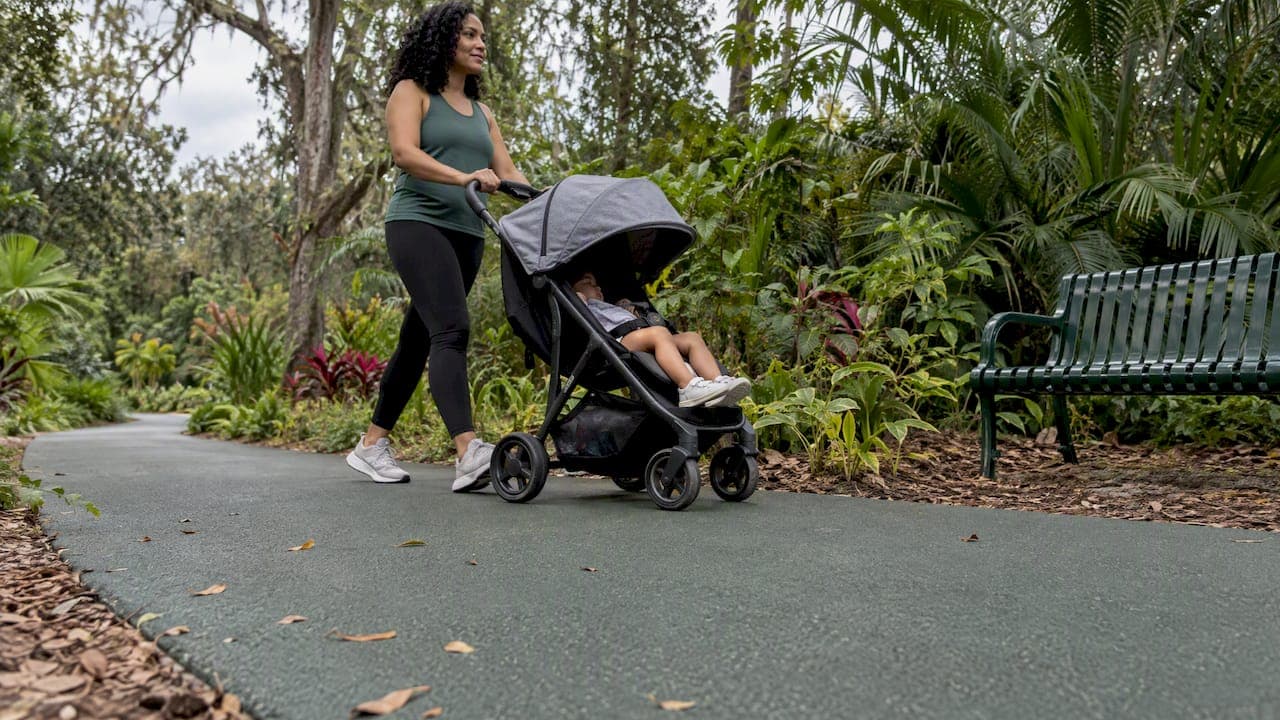
If you search "quiet walkway surface" you will mostly find hiking trails in the Smokies. If you own or manage a path, though, you want something else: a surface that stays quiet under heels, strollers, rolling luggage, carts and maintenance equipment. The short answer is a surface that cushions impact, has few joints and stays firm, stable and slip-resistant. Resilient rubber-bound paving is one of the best fits, especially where drainage and ADA access matter too. This guide explains why, where the trade-offs sit, and how to choose.
TL;DR
- Noise on a walkway comes from impact (heels, hooves, dropped objects), rolling (wheels over joints and texture) and structure-borne vibration. A quiet surface addresses all three.
- Resilient, seamless surfaces such as bonded recycled-rubber paving cushion impact and remove the joints that make wheels rattle. Hard slabs and loose gravel do neither.
- Porous surfaces can also absorb sound, but they need maintenance to keep their pores open, so plan for vacuuming and a sound base.
- In the U.S., any accessible route must be stable, firm and slip-resistant. Quiet is a bonus on top of compliance, never a substitute.
- In Florida, heat, heavy rain and standing water decide how long a quiet surface stays quiet.
Table of Contents
- What actually makes a walkway quiet
- Why porosity helps, and where it has limits
- Quiet walkway materials compared
- Accessibility comes first
- What Florida adds to the problem
- Where quiet surfaces matter most
- How to choose: six criteria
- Our perspective
- Rubber paving from EcoTec
- FAQ
- Sources
What actually makes a walkway quiet
People often describe a loud path as "hard." That is only part of it. Three separate mechanisms create the sound you hear.
Impact noise. A heel, a cane tip or a dropped tool hits the surface and the surface rings. Dense, stiff materials such as concrete and stone return that energy as sound. Elastic materials absorb part of it as a small deformation, so the click is dulled.
Rolling noise. Small hard wheels on strollers, rolling suitcases, golf bags and service carts rumble over every joint, groove and rough patch. Fewer joints and a smoother, more uniform texture mean less rumble. Road engineers see the same pattern at larger scale: the Florida Department of Transportation's Quiet Pavements Synthesis reports that pavements with smooth surface textures, smaller maximum aggregate size and higher porosity generate less noise, because air can move through the voids instead of being pumped out from under the tire.
Vibration and radiated sound. Thin, rigid surfaces can act like a drum. A damped, resilient layer over a compacted base is less likely to resonate.

A useful rule of thumb from European road research is that, for dense asphalt and stone-matrix asphalt, each 1 mm reduction in maximum aggregate size lowers tire-road noise by about 0.25 dB, according to the CEDR report on noise-reducing pavements. That is a road-traffic figure, not a footpath figure, but the principle carries over: finer, smoother texture is quieter.
Why porosity helps, and where it has limits
The pavement industry's reference pages describe quiet paving surfaces as a way to give nearby listeners a calmer outdoor environment where a wall or berm is not practical. The most common designs rely on open voids that let sound energy dissipate inside the surface.
The same Florida DOT synthesis cautions that porous surfaces can absorb sound and reduce noise propagation, though their durability may be lower than conventional dense-graded surfaces. For a walkway the lesson is practical: a porous surface performs only as long as it stays porous. Fine sediment, leaf litter and sand can clog the voids. The Federal Highway Administration's guidance on permeable interlocking concrete pavement recommends inspections once or twice a year, with vacuuming where needed, and that guidance applies in spirit to any permeable surface.

Researchers are also experimenting with rubber in the mix itself. A peer-reviewed study on rubber granules in porous asphalt tested them specifically for damping noise, which tells you where the industry's thinking is headed: elasticity plus porosity.
Quiet walkway materials compared
Here is how common choices behave for a path used by people, strollers, wheelchairs and light carts. This is a general comparison by material type, not a ranking of products.
| Surface type | Footstep noise | Wheel noise | Drainage | Heat and cracking in Florida | Maintenance |
|---|---|---|---|---|---|
| Broom-finished concrete | Loud, hard click | Rumbles at every joint | None unless sloped | Joints and slab cracking over time | Sealing, crack repair, joint upkeep |
| Asphalt | Moderate | Moderate | Low | Softens in heat, ruts and cracks | Sealcoating, patching |
| Pavers (concrete or stone) | Loud to moderate | Noisy over joints | Varies with joint design | Settlement and shifting | Re-leveling, joint sand |
| Loose gravel or stone | Crunchy | Poor for wheels | Good | Migrates in heavy rain | Regular regrading |
| Engineered wood fiber | Soft | Quiet but soft | Needs good drainage | Biological breakdown in humidity | Periodic top-ups |
| Bonded recycled-rubber paving | Soft, cushioned | Quiet, seamless | Porous systems drain through | Designed for heat and weather | Periodic vacuuming |
A few notes behind the table.
Engineered wood fiber is quiet and was developed for accessible trails. The U.S. Access Board's research on stabilized engineered wood fiber notes that effective drainage is critical to keep the native soil stable and to prevent biological deterioration of the wood. In humid, rain-heavy Florida, that is a real constraint.
Gravel is the opposite problem: it drains but is loud, and it is a poor accessible surface for wheels.
Hard surfaces can be perfectly compliant. The Access Board's guide to floor and ground surfaces says concrete, asphalt, tile and wood are sufficiently firm and stable. Compliant and quiet are different questions, however, and a concrete path can pass inspection while still being the loudest thing on the property.
Accessibility comes first
Before you pick for sound, confirm the surface can serve as an accessible route. Under the ADA standards, accessible floor and ground surfaces must be stable, firm and slip-resistant, as the Access Board's surfaces guide explains. That guide also notes that the standards set no minimum slip-resistance value or coefficient of friction, because no consensus rating method has emerged. So a manufacturer saying "ADA-compliant" is a starting point, not proof. Ask for documentation of how the surface was evaluated.
For softer surfaces, firmness matters. The Access Board's research on accessible exterior surfaces recommends a rotational penetrometer to measure firmness and stability objectively. A surface that is quiet because it is squishy fails wheelchair users, so "quiet" must never come from "soft and loose." Resilient bonded rubber is different: it is a bound, continuous layer designed to stay firm while absorbing impact.
If you manage compliance, these pages from our own library go deeper:
- ADA slip resistance requirements and testable specs
- Avoiding inspection failures on ADA-compliant walkways
- Outdoor wheelchair ramp surfaces if your route includes a slope
What Florida adds to the problem
A quiet surface in Maine and a quiet surface in Florida face different enemies.
Heat. Surfaces that expand and contract open joints and cracks. Every crack is a new place for wheels to clatter and for a trip hazard to form.
Rain. Summer storms put a lot of water on a path in minutes. Standing water makes a surface slippery and, for wood or soil-based paths, starts deterioration. Porous construction lets water pass through to a prepared base instead of sheeting across the top. Our guide for stormwater-minded engineers covers how that works at project scale.
Fine debris. Sand, pollen and leaf litter find their way into porous surfaces, which is why a vacuuming schedule belongs in any maintenance plan. Our note on cleaning rubber paving explains the twice-a-year routine.
The base. Any quiet surface sits on something. A poorly graded or soft base telegraphs through the finished layer as dips, ponding and cracks. If your site has vegetation, stumps or uneven ground, professional site clearing and grading services can prepare the footprint and leveling before the surface goes in. The finished walkway is only as good as the ground under it.
Where quiet surfaces matter most
HOA common areas. Pool decks, community paths and amenity entrances sit near homes. Residents notice rolling carts at 7 a.m. and hard footsteps at night. A cushioned, seamless surface lowers the complaints.
Golf courses and clubhouses. Cart paths and clubhouse approaches generate constant rolling and clatter. See our look at how rubber paving reduces golf course noise and our guide to clubhouse walkway surfaces.
Municipal parks, trails and sidewalks. Cities need accessible routes that drain, resist cracking and can be documented for an inspector. Quiet is valued near residences, libraries and schools.
Commercial entrances and retrofits. Retail, medical and hospitality entrances see luggage, carts and delivery wheels. Our commercial walkway retrofit guide and entrance surface installation guide cover the compliance side.
Residential driveways, patios and pool decks. A resilient surface is gentler underfoot, drains away splash water and does not burn bare feet the way some hard surfaces do in summer sun. Color options help it blend with the home.
How to choose: six criteria
- Define the noise source. Footsteps, wheels or both? A path for joggers and a path for rolling luggage have different needs.
- Check firmness and slip resistance for accessibility. Ask what test or documentation supports the claim.
- Look at joints. Fewer joints mean fewer rattles and fewer places for cracks to start.
- Plan the drainage. Know where the water goes. A porous surface needs a base that can accept it.
- Budget for maintenance. Every surface has some. Porous ones need vacuuming; wood needs top-ups; concrete needs crack and joint repair.
- Ask for proof, not adjectives. Noise claims should be tied to a defined test or an installed reference you can walk on. The European SILVIA guidance classifies porous road layers by air void content, from dense layers at 4 to 9 percent to open layers above 19 percent, per the Bruitparif-hosted manual. It is a road standard, but it shows how seriously noise claims are quantified. Walk a finished installation and listen before you commit.
For a broader look at matching surface types to a community, see our planner's guide to slip-resistant community walkways.
Our perspective
We install only rubber paving, so we have spent years listening to what property owners complain about. It is rarely decibels. It is the cart that rattles past a bedroom window, the stroller that bounces over seams, the cracked slab that someone tripped on, the puddle that never dries.
That is why we build around the Rubberway® system: recycled tire material bound into a continuous, porous layer. Resilience handles the impact. The lack of joints handles the rumble. Porosity handles the water. Because the layer flexes with heat rather than cracking along a rigid joint, the surface tends to stay the way it was when it was installed, which is the real test of "quiet."
We will also tell you where rubber is not the right answer. If a site has bad drainage or an unstable base, no surface will save it, and that needs fixing first. If you want a hard, polished look, that is a different product. For paths where people walk, roll and gather, and where neighbors listen, we think resilient rubber is hard to beat.
— Roger
Rubber paving from EcoTec
We are licensed and insured, we focus exclusively on rubber paving in Florida, and we provide government-ready documentation for municipal and HOA projects. Our range covers Rubberway® Pervious Pavement, Rubberrock 6000, EVOLUTION and the Sidewalk System, in a wide range of colors, for driveways, pool decks, patios, commercial walkways, parks, trails and community areas.
If you have a path that is too loud, too slick or too cracked, tell us about the project and we will help you match a system to the site. You can also browse the Rubberway product lines first.
FAQ
What is the quietest surface for an outdoor walkway?
The quietest surfaces are resilient and seamless: they cushion footsteps and give wheels no joints to rattle over. Bonded rubber paving fits that description, as do some soft surfaces such as engineered wood fiber. Wood fiber needs strong drainage to last, so in rainy Florida a porous bonded surface is usually the more durable choice.
Is a quiet walkway surface ADA-compliant?
Not automatically. Accessible routes must be stable, firm and slip-resistant whatever the material, and the ADA standards give no numeric slip-resistance value. Ask the installer for documentation of how the specific system was evaluated, and have it ready for inspectors.
Do porous surfaces stay quiet over time?
They can, if the pores stay open. Debris and fine sediment can clog voids, which reduces both drainage and sound absorption. Regular inspection and vacuuming, typically once or twice a year, keeps a permeable surface working.
Does rubber paving crack in Florida heat?
Rubber paving is designed for heat and weather, and as a continuous flexible layer it does not rely on rigid joints the way slabs do. Results still depend on a sound, well-drained base, which is why site preparation is part of every project we scope.
Sources
- Quiet Pavements Synthesis (FDOT, 2023)
- CEDR report on noise-reducing pavements
- Pavement Noise (Pavement Interactive)
- Permeable Interlocking Concrete Pavement (FHWA)
- Rubber granules in porous asphalt (PMC)
- Stabilized engineered wood fiber for accessible trails (Access Board)
- Floor and Ground Surfaces (Access Board)
- Accessible Exterior Surfaces (Access Board)
- Guidance Manual for Low-Noise Road Surfaces (SILVIA)
- Site clearing and grading services